Mastering Business Decisions for Entrepreneurs
Business Decisions, Entrepreneurship Process, Financial Markets
The First Step of Every Business: Completing the Decision Making Process
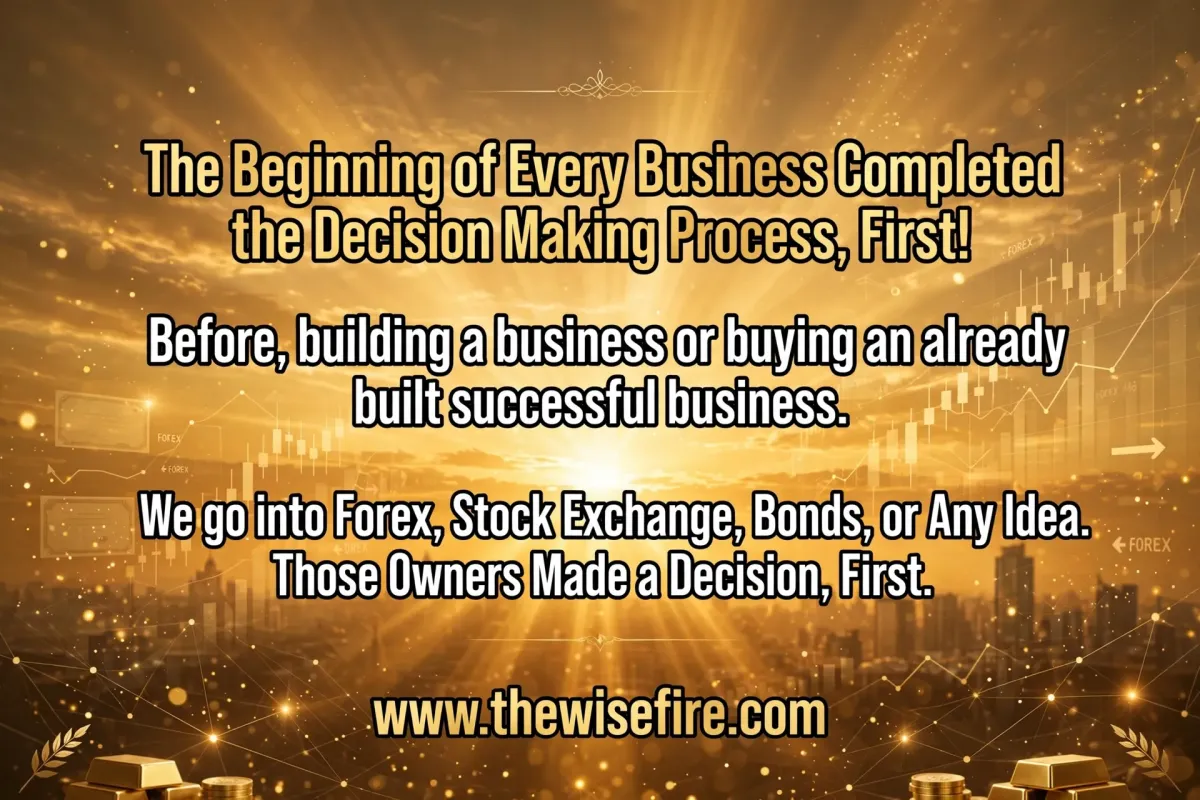
Before a single dollar is invested, a logo is designed, or a trade is placed in the Forex or stock market, one thing always happens first: a clear, committed decision. Every thriving company, every profitable trade, every wise bond purchase began with an individual completing a deliberate decision making process. That inner moment of clarity is where real entrepreneurship starts.
The Invisible Beginning of Every Business
We often celebrate the visible milestones: opening day, first customer, first profitable month, or first winning trade. Yet the real beginning of every business is quieter. It happens when you decide, with intention, “I am going to build this,” or “I am going to buy that.” Long before the paperwork, the entrepreneurship process starts in the mind with a choice to commit time, energy, and money to a specific path.
At www.thewisefire.com, one core belief stands out: wise action follows wise decisions. Whether you are starting a business from scratch, buying an already successful company, or stepping into the financial markets, the quality of your initial decision largely shapes your long-term results. You are not just choosing what to do; you are choosing who to become in the process.
Build a Business or Buy One? The Decision Behind the Strategy
One of the biggest business decisions aspiring owners face is whether to build a business from the ground up or buy an already built, profitable operation. Both paths can lead to success, but they demand very different mindsets, resources, and investment strategies. The decision making process here is not about right or wrong; it is about alignment with your skills, capital, and risk tolerance.
Building a business offers creative freedom. You shape the brand, design the systems, and grow at your own pace. The cost is time, uncertainty, and the need to validate your idea in the marketplace.
Buying an existing business offers proof of concept. There are customers, cash flow, and systems in place. The cost is higher upfront capital and the responsibility to improve what already exists without breaking it.
In both cases, a disciplined entrepreneurship process asks the same questions: What problem am I solving? What resources do I control? What risks am I willing to accept? When you answer these honestly, you complete the first stage of decision making and move from dreaming to acting.
Decision Making in the Financial Markets: Forex, Stocks, and Bonds
The same principle applies when you step into Forex, the stock exchange, or the bond market. No trade is truly “quick.” Before you click buy or sell, you have already made a chain of decisions: which market to focus on, what strategy to follow, how much to risk, and how long to stay in the position. The most successful traders treat this as a structured decision making process, not a guess.
In Forex, you are deciding on currency pairs, leverage, and timing. You are effectively judging the strength of one economy against another and committing capital to that view.
On the stock exchange, you are choosing businesses to partner with as a shareholder. You decide which industries you believe in, how much volatility you can handle, and whether you are trading short term or investing long term.
With bonds, you are deciding who to lend money to and for how long. Governments and corporations promise interest in return for your trust. Your decision here reflects your appetite for stability versus higher potential returns elsewhere.

Strong investment strategies begin with clear criteria, not emotional reactions to price.
Turning Ideas into Intentional Investment Strategies
Many people have ideas: “I should start a café,” “I should trade Forex,” “I should buy bonds for retirement.” What separates action-takers from daydreamers is the willingness to slow down and complete a real decision process. That means moving from vague desire to concrete investment strategies and written plans.
A simple but powerful framework is:
Clarify your objective: Are you seeking income, growth, freedom, or security?
Assess your resources: Time, skills, capital, and emotional resilience all matter.
Define your rules: Entry, exit, risk per trade or per project, and time horizon.
Commit in writing: When your choices are written, your mind recognizes that a real decision has been made.
💡 Pro Tip: If you cannot clearly explain your business or investment decision on one page, you are not ready to risk serious capital yet.
Your Next Step: Decide Before You Dive In
Whether you dream of owning a local business, acquiring a profitable company, or navigating Forex, stocks, and bonds, remember this: the real starting line is not your first investment, but your first completed decision. The more intentional your business decisions are, the more powerfully you can move through the entrepreneurship process and the financial markets with confidence instead of fear.
Take time today to sit quietly with your ideas. Ask yourself what you truly want to build or buy, how you want to participate in the markets, and what risks you are genuinely willing to take. Then write down your answers, refine them, and let that clarity guide your next move. Every successful owner you admire once stood where you are now—at the edge of a choice. They moved forward because they decided, first.
For more insights on Decision Making, Goal Setting, and building a powerful Success Principles foundation, explore the resources at www.thewisefire.com or you can click the link below & Connect with an Idea Integrator. The moment you truly decide, your millionaire journey has already begun.


