The Money Control Wheel: Smart Financial Decisions
Money, Decision Making, Voters, Business, Investing
The Money Control Wheel: How Wise Decisions Power Businesses, Investors, and Voters
Every business, investor, and voter lives or dies by the quality of their decisions. When you understand the universal principles of money and use them like a pilot uses an instrument panel, you stop guessing and start steering your financial life with confidence. This article explores how decision making, first-principles thinking, and the MONEY CONTROL WHEEL can help you control, monitor, optimize, and grow your financial health—whether you are running a company, managing investments, or casting a vote that shapes your nation’s money supply.
Decision Making: The Invisible Engine Behind Every Business and Investment
Strip away the jargon, the spreadsheets, and the headlines, and you will find one simple truth: all business and investing is decision making. A founder decides what to sell, at what price, and to whom. An investor decides which assets to buy, hold, or sell. A family decides how to spend, save, and borrow. Each choice either strengthens or weakens their financial position.
Modern corporate finance still rests on three classic decision principles:
Investment decisions – Only invest when expected returns exceed the cost of capital and the risk is acceptable (NYU Stern, 2026).
Financing decisions – Choose the right mix of debt and equity to support growth without overloading risk.
Dividend decisions – When there are no good opportunities, return surplus cash to owners.
Whether you are a global CEO or a solo investor with a modest portfolio, you are answering the same three questions in everyday language: Can I afford this? Will this make money? What is the real return? These are universal money questions, and they demand a clear framework rather than gut feel alone.
James A. Garfield and the Power of a Simple Money Equation
Long before modern dashboards and analytics, U.S. President James A. Garfield understood the value of clear, structured thinking. Garfield, known for his sharp intellect and love of mathematics, famously published an original proof of the Pythagorean theorem while still a member of Congress. He showed that complex truths could be reduced to simple, elegant relationships.
The same mindset applies to money. When you break financial decisions into first principles, you gain the kind of clarity Garfield prized. Instead of seeing price, profit, and tax as mysterious forces, you see them as parts of a straightforward equation you can control. This is the spirit behind the formula: Price = Cost of Goods + Labour + Overhead + Pay Yourself + Taxes + Profit .
First-Principles Money: The Price Formula That Puts You in Control
First-principles thinking means starting from the most basic truths and building up. Instead of asking, “What do others charge?” you ask, “What must this price cover to make the business healthy?” The formula Price = COG + Labour + Overhead + Pay Yourself + Taxes + Profit is a first-principles map of where every dollar of revenue must go.
Cost of Goods (COG) – The direct cost to produce or deliver: materials, production, shipping-in, and direct service inputs.
Labour – Wages and benefits for the people who create, deliver, or directly support the product or service.
Overhead – Rent, utilities, software, insurance, and all the indirect costs that keep the lights on.
Pay Yourself – A deliberate allocation to the owner or primary decision maker, separate from profit. This protects you from being the last person paid.
Taxes – The unavoidable share owed to government; it must be planned, not hoped for.
Profit – The surplus that rewards risk, funds growth, and cushions future shocks.
💡 Pro Tip: When you cannot explain your price using this formula, you are not in control of your business—you are guessing.
Introducing the Money Control Panel: Your Financial Cockpit
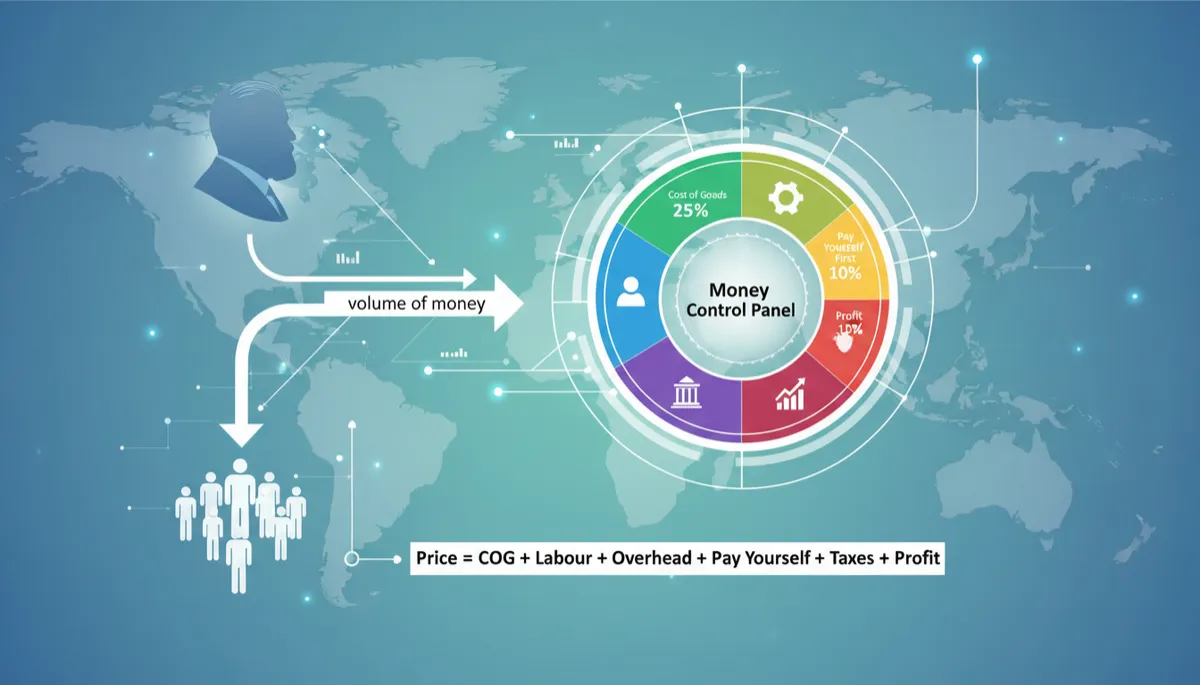
Imagine flying a plane with no instruments. You might stay in the air for a while, but you would have no idea about altitude, speed, or direction. Many people run businesses—and even national economies—like that. A Money Control Panel is the opposite approach: a clear dashboard that shows where your money is coming from, where it is going, and whether you are on a safe, profitable course.
In 2026 and beyond, a Money Control Panel can be digital and intelligent: a unified view of bank accounts, loans, taxes, investments, and cash flow, often enhanced by AI to provide alerts, forecasts, and suggestions (Finextra, 2026). Whether simple or advanced, the purpose is the same: to give you real-time control over key levers: costs, income, savings, taxes, and profit.
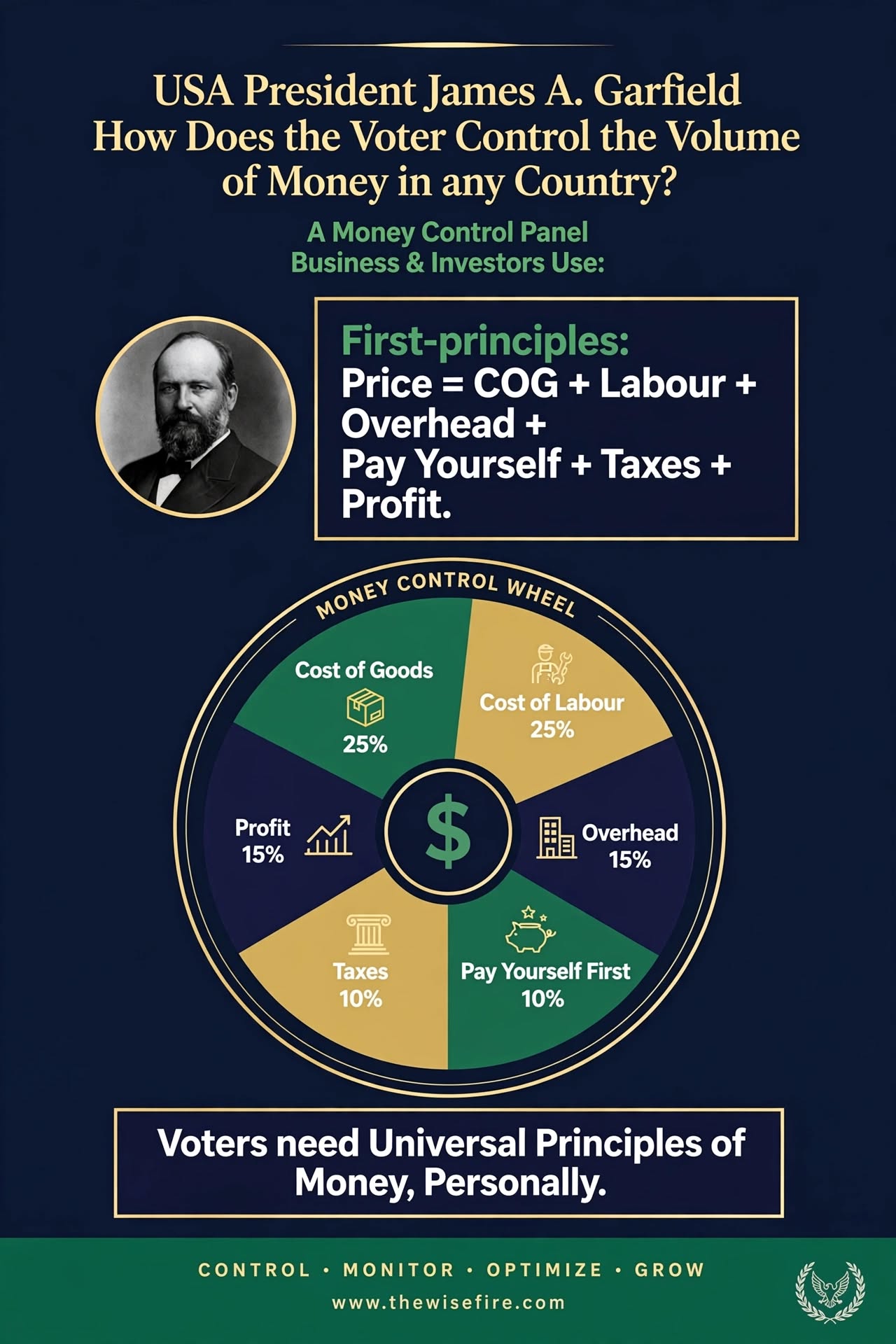
A clear Money Control Wheel turns abstract finances into simple, adjustable levers.
The MONEY CONTROL WHEEL: Six Core Areas and a Balanced Budget
The MONEY CONTROL WHEEL, as outlined on www.thewisefire.com, turns the price formula into a visual tool. Picture a wheel divided into six slices. Each slice represents a core area of your financial life, with a target percentage of your total revenue or budget:
Cost of Goods (COG): 25%
Cost of Labour: 25%
Overhead: 15%
Pay Yourself First: 10%
Profit: 15%
Taxes: 10%
Together, these add up to 100%. That is a balanced budget: every unit of income has a job. If one slice grows too large, another must shrink, or the wheel becomes distorted and your finances wobble. Let us explore each area in depth.
1. Cost of Goods (25%): Start With Industry Reality
Cost of Goods (COG) is your first anchor. It includes materials, manufacturing, shipping-in, and direct service inputs. Because COG is so industry-specific, it must be researched against industry standards, not guessed. Benchmarks show that:
Software and SaaS often achieve gross margins of around 60–85%, implying COG of only 15–40%.
Grocery retail may operate at 20–30% gross margin, meaning COG can be 70–80% of sales (Basis Report, 2026).
The 25% COG slice in the MONEY CONTROL WHEEL is a guiding target, especially useful for service businesses, knowledge work, and many small enterprises. The wise move is to: compare your COG percentage with trusted benchmarks in your own sector, then adjust pricing, sourcing, or product design until your COG slice supports a sustainable wheel.
📌 Key Takeaway: You cannot control profit until you understand and control COG. Research your industry, then design your wheel around reality—not wishful thinking.
2. Cost of Labour (25%): Powering the Engine Without Burning It Out
Labour is often your largest controllable expense—and your greatest asset. Allocating 25% of revenue to labour forces discipline: you must hire wisely, automate where sensible, and ensure each role creates clear value. For investors, a business with labour costs wildly above its peers may signal inefficiency; one with labour far below may be underinvesting in talent and service quality.
Use your Money Control Panel to track labour as a percentage of revenue monthly. If it creeps above 25%, you have three levers: improve productivity, adjust pricing, or redesign the offer. The decision is strategic, not emotional.
3. Overhead (15%): The Silent Budget Killer
Overhead—rent, software subscriptions, utilities, vehicles, admin salaries—tends to grow silently. The MONEY CONTROL WHEEL caps overhead at 15%. That cap is a protection mechanism: if overhead expands unchecked, it eats directly into profit, owner pay, or both.
On your Money Control Panel, treat overhead like a fuel gauge. When it rises, you either trim non-essential costs or consciously raise prices. The key is awareness: a balanced budget requires overhead to serve the mission, not dominate it.
4. Pay Yourself First (10%): Protect the Decision Maker
Many owners and key decision makers pay everyone else first and hope something is left for them. Over time, this leads to burnout, resentment, and poor decisions. The MONEY CONTROL WHEEL dedicates 10% of revenue to Pay Yourself First. This is not a luxury; it is a structural safeguard.
When you know you are paid fairly, you can make calm, rational decisions about pricing, staffing, and investment. If the numbers do not allow you to allocate that 10%, the message is clear: the business model or pricing needs to change. The wheel exposes the truth so you can act.
5. Profit (15%): The Margin of Safety and Growth
Profit is not what is left over; it is a planned slice of the wheel—15% by design. This profit funds growth, repays debt, builds reserves, and rewards risk. Across U.S. public companies, average net profit margins hover around 9–10% (Christoph Olivier Consulting, 2026), so a 15% profit target is ambitious but achievable for many focused small and mid-sized businesses.
For investors, a healthy, recurring profit slice signals that management understands discipline and long-term value creation. For owners, it is the difference between constant stress and strategic freedom.
6. Taxes (10%): Plan It, Do Not Fear It
Taxes are often treated as a surprise, but they are predictable within ranges. Allocating 10% of revenue to taxes on your MONEY CONTROL WHEEL transforms tax from a shock into a line item. You save throughout the year instead of scrambling at year-end.
A balanced budget respects taxes as part of the real cost of doing business. On your Money Control Panel, monitor tax provisions monthly so you always know where you stand with the government—and can sleep at night.
Why a Balanced Budget Matters for Stability and Growth
A balanced budget is not about perfection; it is about intentional design. When your spending and allocations match your plan, you:
Avoid hidden leaks that quietly erode profit and savings.
Gain the confidence to invest, hire, or expand, because you know your baseline is stable.
Build resilience to shocks—economic downturns, policy changes, or unexpected expenses.
The MONEY CONTROL WHEEL makes balance visual. If one slice swells, you immediately see which other slice is being squeezed. That visibility is what turns financial chaos into conscious choice.
How Voters Control the Volume of Money in a Country
It is easy to think that central banks and politicians alone control the money supply. In reality, voters hold the ultimate remote control. Through elections and public pressure, citizens decide who writes the rules for:
Government spending – Budgets for infrastructure, welfare, defense, and subsidies that inject money into the economy.
Tax policy – How much is collected, from whom, and on what, shaping how money flows between citizens, businesses, and the state.
Regulation of banks and credit – Rules that affect how easily banks can create new money through lending.
When voters choose leaders who favour aggressive borrowing and loose credit, the volume of money in circulation tends to expand. When they choose leaders focused on austerity and tight credit, money growth slows. Over time, these decisions influence inflation, interest rates, asset prices, and job creation.
In other words, every vote is a financial decision. Understanding universal money principles—like balanced budgets, sustainable debt, and the importance of real productivity—helps voters choose policies that support long-term prosperity instead of short-term illusions.
Universal Principles of Money: What Every Voter, Business Owner, and Investor Should Know
Across all levels—personal, business, and national—certain principles repeat. The frameworks shared on The Wise Fire echo what decades of financial research confirm:
You get what you measure. If you do not track COG, labour, overhead, taxes, and profit, you cannot improve them.
Cash flow is survival; profit is progress. Without cash, you cannot meet obligations. Without profit, you cannot grow or withstand shocks.
Debt is a tool, not a solution. Used wisely, it accelerates growth; used blindly, it magnifies mistakes.
Incentives drive behaviour. How you allocate slices of the MONEY CONTROL WHEEL shapes how people act inside a business or government.
When voters grasp these principles, they can evaluate policies like a seasoned investor evaluates a company: Is the budget balanced? Is spending productive? Are we paying ourselves (as citizens) in real opportunity, or just with borrowed promises?
Control, Monitor, Optimize, Grow: Using the Money Control Wheel in Real Life
1. Control: Set Your Targets
Start by drawing your own MONEY CONTROL WHEEL with the six slices and target percentages. This is your control blueprint. For each slice, define:
Current percentage of revenue you spend there.
Target percentage based on the your industry benchmarks.
2. Monitor: Build Your Money Control Panel
Next, create a simple dashboard—your Money Control Panel. This can be a spreadsheet, a budgeting app, or a full-featured financial tool. The key is to track each slice monthly:
Revenue and price per unit.
Actual spend on COG, labour, overhead, taxes, owner pay, and profit.
Modern tools increasingly use AI to project cash flow, flag overspending, and suggest adjustments (McKinsey, 2026). But even a simple manual panel, updated consistently, can transform your decision making.
3. Optimize: Adjust the Levers
Once you can see the wheel and the panel, optimization becomes a series of deliberate experiments:
Can you renegotiate supplier contracts to reduce COG without sacrificing quality?
Can you refine processes or use technology to keep labour at 25% while increasing output?
Can you trim non-essential overhead and redirect that money to profit or owner pay?
Treat each change as a test: adjust, monitor the impact, and keep what works. Over time, your wheel becomes smoother and stronger.
4. Grow: Scale With Discipline
Growth without control is dangerous. But when your MONEY CONTROL WHEEL is balanced and your Money Control Panel is active, scaling simply means:
Increasing revenue while keeping each slice within its target percentage.
Using planned profit to fund expansion instead of relying solely on debt.
For voters, “growth with discipline” translates into supporting policies that encourage productive investment, fair taxation, and transparent budgeting—so the national Money Control Wheel stays balanced too.
Bringing It All Together: From Garfield’s Clarity to Your Next Decision
James A. Garfield showed that even complex truths can be explained with a simple, elegant proof. Money is no different. When you:
Use first principles like Price = COG + Labour + Overhead + Pay Yourself + Taxes + Profit,
Design and respect a balanced MONEY CONTROL WHEEL,
Build a Money Control Panel to control, monitor, optimize, and grow,
And vote with an understanding of how policies affect the volume and direction of money,
you move from being a passenger in the financial system to being a pilot. Businesses become more resilient, investments more intentional, and nations more stable—one wise decision at a time.
The universal principles of money are not reserved for experts. They are tools for every owner, investor, and voter willing to learn them. The next move is yours: will you leave your financial future to chance, or will you take hold of the Money Control Wheel and steer?
For more insights on Decision Making, Goal Setting, and building a powerful Success Principles foundation, explore the resources at www.thewisefire.com or you can click the link below & Connect with an Idea Integrator. The moment you truly decide, your journey has already begun.


