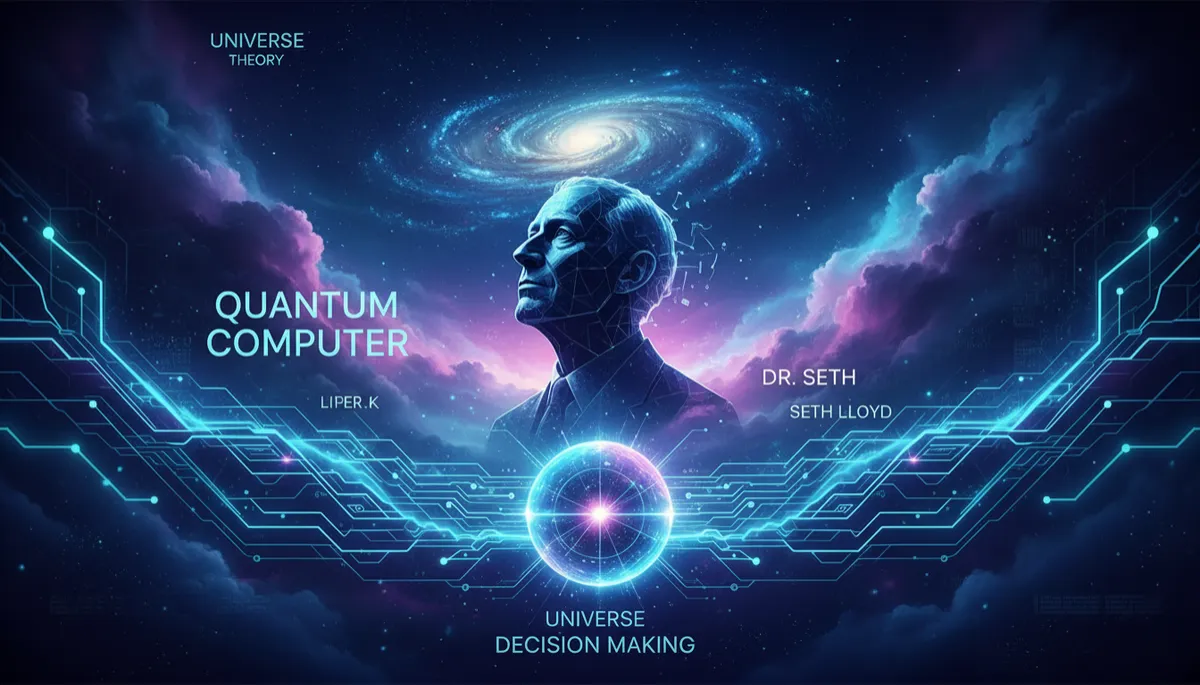
Quantum Mechanics in Market Decision Making
Finance, Quantum Mechanics, Decision Making
What Seth Lloyd Taught Me About Decision Making in Markets
How a physicist’s view of the universe as a Quantum Computer reshaped the way I think about the skills behind everyday financial decisions, from building a retirement plan to choosing between paying down debt and investing.
Completing the Decision Making Process First
Before Seth Lloyd ever declared, “I will show that the universe can be regarded as a giant quantum computer,” he had to do something far more human: complete a decision making process. He weighed evidence, framed hypotheses, challenged assumptions, and only then committed to a bold statement about Universe Theory and Quantum Mechanics.
Everyday investors face a similar sequence, even if they never open a trading platform. Before you decide whether to max out a Roth IRA, refinance a mortgage, or keep extra cash in a savings account, you’re running a quiet but critical decision loop: define the question, gather information, compare scenarios, and only then act. Personal finance punishes half-finished thinking just as science punishes half-finished theories.
📌 Key Takeaway: Good financial choices, like good theories, start with a fully completed decision process, not a hunch.
The Universe as a Giant Quantum Computer – A Personal Finance Lens
When Seth Lloyd framed the universe as a giant Quantum Computer, he wasn’t just being poetic. In Quantum Mechanics, every interaction “computes” an outcome from many possibilities. Your financial life works the same way: every paycheck, bill, impulse purchase, and savings decision is like a tiny operation in a vast personal balance-sheet computer, constantly updating your net worth.
Thinking this way changes how you approach money. Instead of searching for certainty—“Will this stock double?” or “Is this the perfect time to buy a house?”—you acknowledge that your financial future, like the universe, evolves through probabilities. Your job is not to be right every time, but to structure decisions so that, over many “computations,” your outcomes skew positive.

Blending probabilistic quantum thinking with structured money rules sharpens everyday financial choices.
Turning Quantum-Inspired Thinking into Concrete Money Rules
In this scenario, imagine a young professional, Maya, facing a familiar dilemma. Each month, she has $500 left after covering her essentials. One path leads toward extra payments on her student loans; another leads toward buying a broad-market index fund; a third keeps the money in cash as a growing buffer. The numbers are real, but the tension is emotional: urgency to erase debt versus fear of “missing the market.”
Viewed through a quantum-inspired lens, her situation is not a single, all-or-nothing choice. It is a small universe of possible states: loan payoff, investing, emergency savings, or holding cash. Each option carries its own probability of comfort or regret. Instead of chasing a perfect answer, the goal becomes designing a decision making framework that respects uncertainty but remains disciplined, much like a program running on a quantum computer that processes many paths before settling on an output.
As Maya maps out her options, three lessons surface. First, listing every realistic destination for that $500—extra loan payment, index fund, emergency fund, or additional cash—turns a fog of worry into a clear state space she can see on paper. Second, when she notices that her emergency savings barely cover one month of expenses, the trade-off between “slightly less debt” and “a few months of breathing room” becomes obvious; downside protection must come before aggressive offense. Third, when she compares her loan’s after-tax rate of about 4% with a conservative 5–6% expectation for long-term stock returns, she stops framing the choice as right versus wrong and starts seeing it as certain cost versus uncertain return.
From there, a blended solution emerges. Rather than forcing herself into a single path, Maya splits her surplus once an emergency cushion is in place: part of the $500 goes to a low-cost index fund, part to extra loan payments. The plan is not mathematically “perfect” in a textbook sense, but it aligns with how her mind handles risk. She can watch her debt balance fall faster—easing psychological pressure—while also seeing an investment account grow and connect her to long-term market upside. Over time, this repeatable pattern feels less like guessing and more like running a personal program: inputs, rules, and outputs that compound month after month.
Maya’s experience is not a script to copy line by line, but it does reveal the structure behind applying Universe Theory to money. She defines her universe of options, accepts that uncertainty is built into every path, and converts vague anxiety into a small set of rules she can repeat. The real shift is not only in her account balances; it is in the decision skill she is training each time she follows her plan, much like a system that becomes more reliable as its underlying algorithm is refined.
A Simple 3-Step Quantum-Inspired Money Process
Define your universe of options. List every realistic use for your surplus cash—debt payoff, investing, emergency savings, or holding more in cash—so the problem shifts from a vague feeling to a visible map of choices.
Rank by protection and probability. Check your safety net first, then compare guaranteed returns (like the interest saved by paying debt) with expected but uncertain returns (like long-term stock gains), and decide what mix fits your risk comfort.
Turn the choice into a repeatable rule. Convert your decision into a simple monthly rule—such as a set split between savings, investing, and debt payoff—and run that rule consistently so your “program” can compound over time.
💡 Pro Tip: When you feel stuck between paying down debt and investing, write your situation as a short story. Name the characters (you, your future self, your risks), lay out the scenes (job loss, market swings, surprise expenses), and notice which ending actually lets you sleep at night. The narrative you can live with often reveals the rules you should follow.
Bringing It Back to Your Own Portfolio
You don’t need a PhD in Quantum Mechanics to learn from Seth Lloyd. What matters for you, as an individual, is his sequence: complete the decision making process first, then commit. Define your financial universe—accounts, debts, and goals—write down your rules, and accept that each choice is one probabilistic step in a much larger computation: your life’s own giant “quantum computer.”
In the end, your wealth trajectory is the sum of thousands of small, structured decisions. If the universe can compute galaxies, you can certainly compute a better way to save, borrow, and invest—provided you think as carefully about your decision skills and processes as Seth Lloyd did about this universe.
For more insights on Decision Making, Goal Setting, and building a powerful Success Principles foundation, explore the resources at www.thewisefire.com or you can click the link below & Connect with an Idea Integrator. The moment you truly decide, your journey has already begun.


